

Artificial insemination (AI)
Indicated when the woman is young, the tubes are permeable and the seminogram is normal or with mild alterations.

Your diagnosis
Secondary infertility occurs when a couple who has already had a child naturally fails to conceive again after 12 months of regular, unprotected intercourse (6 months if the woman is over 35 or has other risk factors).
It differs from primary infertility, in which a pregnancy has never been achieved.
Although it may seem surprising, secondary infertility is a fairly common condition and can cause frustration, as many people don't expect to experience difficulties after having their first child.
Difficulty in achieving a second pregnancy may be due to different factors:
A fertility study is the first step in determining the cause. It includes:
Semen analysis to analyze the quantity and quality of sperm.
Indicated when the woman is young, the tubes are permeable and the seminogram is normal or with mild alterations.

The most common treatment, especially if there are abnormalities in ovarian reserve, semen, or fallopian tubes. It allows eggs to be fertilized in the laboratory and an embryo transferred to the uterus.
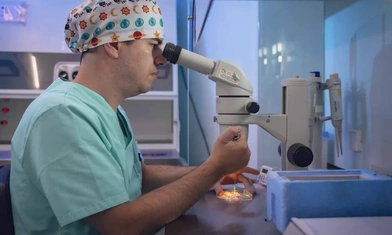
In cases where the quality of the gametes makes pregnancy with one's own eggs or sperm very difficult, donation is used, with high success rates.

Depending on the clinical situation, techniques such as preimplantation genetic diagnosis (PGT), surgical hysteroscopy, or hormonal treatments may be recommended.
Secondary infertility can lead to feelings of guilt, frustration, and sadness. Couples often compare themselves to the ease of their first pregnancy.
Psychological support specialized in assisted reproduction is key to supporting patients throughout the process and helping them manage anxiety.
The prognosis depends primarily on the woman's age, the identified cause, and the duration of infertility.
In many cases, with a proper diagnosis and personalized treatment, the chances of achieving another pregnancy are very high.
Primary infertility affects couples who have never achieved pregnancy. Secondary infertility occurs after having had at least one child.
In cases of severe male factor infertility, before performing in vitro fertilization with intracytoplasmic sperm injection (ICSI), it is important to study testicular meiosis to rule out genetic abnormalities in sperm that could lead to repeated pregnancy failures or embryonic abnormalities. In some cases, if there is a sufficient number of spermatogenesis cells, this study can be performed on semen.
In cases of severe male factor infertility, before performing in vitro fertilization with intracytoplasmic sperm injection (ICSI), it is important to study testicular meiosis to rule out genetic abnormalities in sperm that could lead to repeated pregnancy failures or embryonic abnormalities. In some cases, if there is a sufficient number of spermatogenesis cells, this study can be performed on semen.
In cases of severe male factor infertility, before performing in vitro fertilization with intracytoplasmic sperm injection (ICSI), it is important to study testicular meiosis to rule out genetic abnormalities in sperm that could lead to repeated pregnancy failures or embryonic abnormalities. In some cases, if there is a sufficient number of spermatogenesis cells, this study can be performed on semen.
In cases of severe male factor infertility, before performing in vitro fertilization with intracytoplasmic sperm injection (ICSI), it is important to study testicular meiosis to rule out genetic abnormalities in sperm that could lead to repeated pregnancy failures or embryonic abnormalities. In some cases, if there is a sufficient number of spermatogenesis cells, this study can be performed on semen.
At Institut Marquès, we specialize in the study and treatment of secondary infertility.
We offer a comprehensive diagnosis and a personalized plan to help you fulfill your desire to expand your family.
Request your free initial consultation and have all your questions answered by our specialists.

One of our team members will be in touch shortly through your preferred method of communication.
Fill out the form and we will contact you to arrange a visit with a specialist in Assisted Reproduction.
