In Vitro Fertilisation is particularly indicated in the following situations:

The success of In Vitro Fertilisation is measured through the pregnancy rates achieved with embryos generated from a single egg retrieval. This includes the transfer of fresh embryos and any possible frozen ones. At Institut Marquès, we are proud to say that we have achieved excellent results transferring a single embryo in 90 % of IVF treatments.
| Situation | Average frozen embryos | Average transferred embryos |
|---|---|---|
| <35 years — Partner’s sperm | 4,0 | 1,2 |
| <35 years — Donor sperm | 3,6 | 1,1 |
| 35–39 years — Partner’s sperm | 3,2 | 1,2 |
| 35–39 years — Donor sperm | 3,5 | 1,1 |
| ≥40 years — Partner’s sperm | 2,3 | 1,3 |
| ≥40 years — Donor sperm | 2,4 | 1,2 |
When a partner's sperm presents a problem, in the case of single women or lesbian couples, it is necessary to use donor sperm.
At Institut Marquès, we have our own sperm bank with more than 2,000 premium donors. These are anonymous donors, as Spanish Law 14/2006 of May 14th on assisted human reproduction techniques establishes that donation must be anonymous, voluntary, informed, and unpaid.
Having our own sperm bank allows us to know the donors and select only the best. These are young men who decide to donate to help others start a family and who must pass rigorous medical and psychological tests. We also have access to all sperm phenotypes to find the most suitable match for each case. At Institut Marquès, the doctor personally selects the most suitable sperm donor for each patient, taking into account their physical characteristics and inherited personality traits. We strive for the perfect match.
Known or non-anonymous donors: Gamete donation in Spain is anonymous; if you prefer to undergo treatment with known or non-anonymous donors, this must be done at one of the clinics that collaborate with Institut Marquès.

Who is this treatment for?
This procedure consists of repeating several cycles of ovarian stimulation (before proceeding to embryo transfer) to accumulate enough eggs. In this way, after fertilisation, more quality embryos are obtained and therefore, the chances of successful IVF are increased.
IVF offers multiple advantages, including the possibility of overcoming fertility problems in both men and women, the option of selecting higher quality embryos, and the ability to perform pre-implantation genetic testing to detect possible hereditary diseases.
IVF itself is generally not painful, although some procedures, such as egg retrieval and hormone injections, can cause temporary discomfort. Patients often describe these symptoms as similar to those of premenstrual syndrome.
The cost of an IVF cycle can vary considerably depending on the clinic and country, but it generally ranges from €4,000 to €10,000. This cost includes, among other things, the egg retrieval, fertilization in the laboratory, and embryo transfer, although additional costs may apply for services such as embryo cryopreservation.
Ovarian stimulation is a crucial stage in IVF, where hormonal medications are used to stimulate the ovaries to produce multiple eggs in a single cycle. This process increases the chances of success by providing several eggs to fertilize.
Ovarian stimulation typically lasts about 10 days, depending on the ovaries' response to the medication. During this time, ultrasound scans and blood tests are performed to adjust the medication dosage and schedule the egg retrieval.
Ovarian puncture is a minimally invasive procedure performed under sedation to retrieve eggs from ovarian follicles. Using a fine needle guided by ultrasound, the eggs are collected and prepared for fertilization in the laboratory.
Ovarian puncture may cause mild discomfort or abdominal cramping after the procedure, but it is performed under sedation to minimize pain during the intervention. Most women can resume their normal activities the following day.
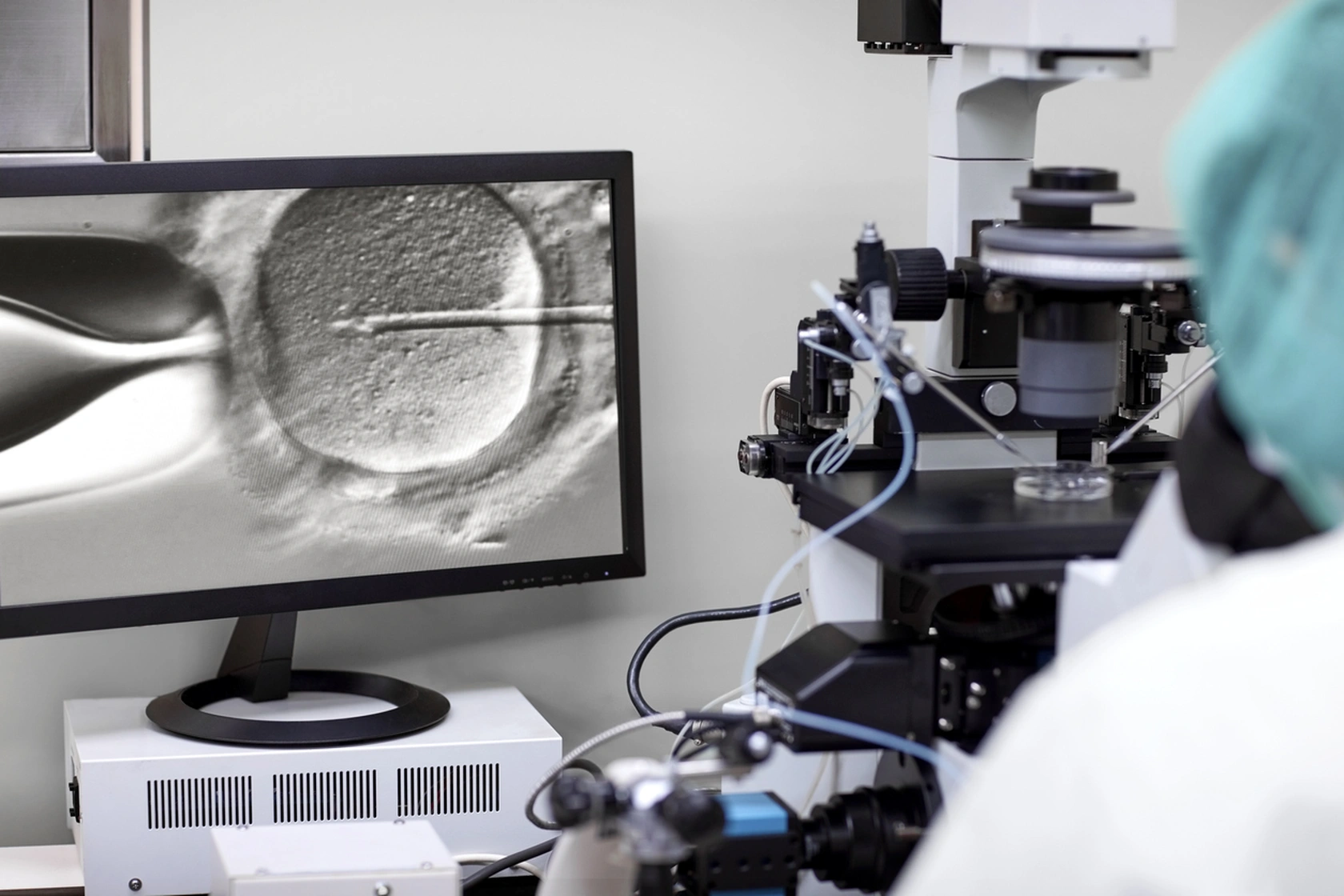
In vitro fertilization (IVF) takes place in a laboratory where collected eggs are combined with sperm. At Institut Marquès, this is done using intracytoplasmic sperm injection (ICSI), a process in which a single sperm is injected directly into an egg.
Embryo transfer is generally performed between 3 and 5 days after fertilization, when the embryos have reached the blastocyst stage. This allows for the selection of embryos with the highest implantation potential.
The number of embryos to transfer depends on several factors, including the woman's age and the quality of the embryos. At Institut Marquès, we transfer a single embryo in over 90% of cases. This demonstrates that the chances of success do not decrease, thus avoiding the risks associated with multiple pregnancies.
Embryos not used in the transfer can be cryopreserved for future pregnancy attempts. There is also the option of donating the embryos to other couples or using them for research purposes.
Embryos can be frozen and stored for several years without losing their viability. The decision of when to use these embryos depends on the couple's reproductive plans.